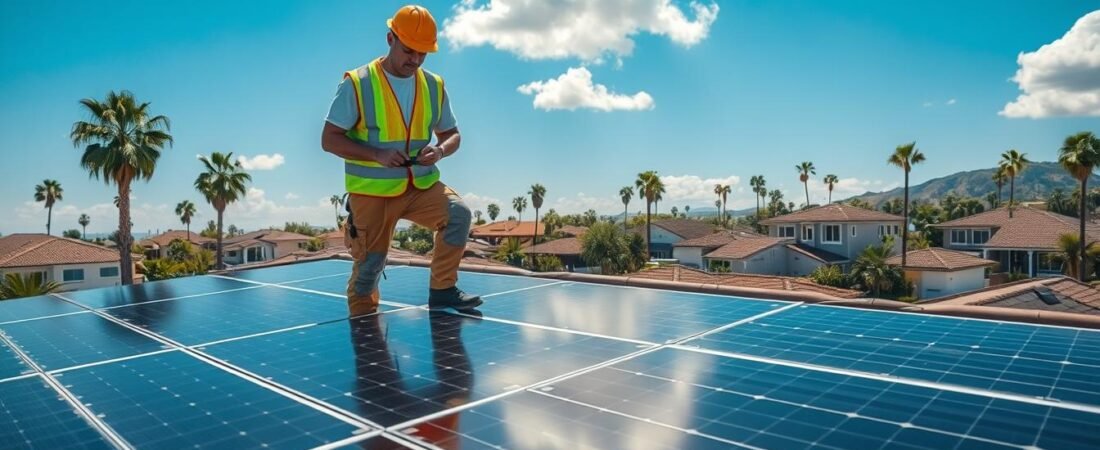
Thinking about going green in California? This buyer’s guide helps homeowners choose the right setup, installer, and financing without the jargon. It focuses on what matters now: net billing changes, time-of-use rates, and why batteries are moving from optional to common.
What “solar panel installation ca” usually covers: site assessment, system design, permits, installation, inspections, and utility permission to operate. We walk you through system sizing, equipment choices, comparing quotes, and vetting contractors so you make informed trade-offs.
Electricity prices vary widely across utilities — PG&E, SCE, and SDG&E show much higher rates than many municipal systems — so economics depend on your utility territory, roof condition, and household load.
This guide is for homeowners who are shopping for quotes, thinking about adding storage, or seeking better bill control and backup resilience. Read on to get clear, practical steps tailored to California buyers.
Key takeaways: This guide simplifies steps, highlights cost drivers by utility, and previews NEM 3.0, time-of-use, and battery considerations.
Why Californians Are Going Solar Now
Rising retail electricity costs are turning homeowner interest into action across the state. California residential rates jumped from roughly 22.8¢/kWh in 2021 to about 31.9¢/kWh by 2024, which raises the value of every kilowatt-hour you don’t buy from the grid.
Electricity rates are rising faster than the national average
Higher retail prices mean each hour your system produces is worth more in real dollars. That makes immediate reductions in your monthly bill more likely and shortens payback timelines.
Why savings can be larger for PG&E, SCE, and SDG&E customers
Investor-owned territories often start from a higher retail rate. That gap translates into bigger near-term savings for those customers compared with many municipal utility areas.
How clean energy improves bill control over time
Going solar and adding storage aren’t just about free power. They reduce exposure to future rate hikes and give homeowners more control over when and how they use energy.
- Value per kWh: Rising rates increase the dollar value of self-generated electricity.
- Timing: Locking in predictable costs is a strong motivation for going solar today.
- Local impact: Your utility and rate plan will change the financial outcome, so compare offers carefully.
For a deeper look at timing and regional economics, see why now is the best time to go solar in.
How Solar Panel Installation Works in California
Start with a site visit and bill review. A trusted installer will examine past energy use, check the roof age and condition, and map shade from trees or chimneys.
Designers then turn goals into a plan. They size a system to meet your offset target, factor in future EV or heat-pump needs, and pick equipment that fits your budget and roof layout.
Permits, utility paperwork, and inspections
Local building permits and interconnection forms with your utility are required. Inspectors typically visit after the install to verify safe wiring and mounting.
“Choose an installer you trust—this crew will drill into your roof and handle long-term service.”
What a typical day looks like
On install day crews mount racks, attach panels, and run wiring to the inverter or battery. In many straightforward cases, a 20–30 panel job can finish in a few hours; complex roofs take longer.
| Step | What happens | Who needs to be ready |
|---|---|---|
| Assessment | Bill review, roof check, shading | Homeowner provides bills, attic access |
| Permits | Local permit + utility interconnect | Installer files paperwork, homeowner signs |
| Final hookup | Inspection, Permission to Operate (PTO) | Utility grants PTO; system can export and earn credits |
- Pro tip: Confirm roof repairs before crews arrive.
- Be available for inspection windows and attic access.
Solar panel installation ca: What Changes Under NEM 3.0 Net Billing
Under NEM 3.0, new customers receive time-varying, wholesale-based credits for exports instead of full retail offsets. That one shift changes how you value exported energy and how you plan a system.
Net metering vs. net billing in plain English
Net metering gave full retail credit for what you exported. It was simple: send out 1 kWh, get 1 kWh credit back.
Net billing pays lower, time-varying credits tied to wholesale rates. Exports now earn less than retail and change hour by hour.
Why export credits average about 25% of retail
Wholesale-based values tend to average roughly a quarter of retail rates. That means exports matter less for bill savings.
Buyer implication: maximize self-consumption and rethink system size and orientation.
Time-varying export values and why evenings matter
Credits can climb when grid demand peaks, often in the evening. That’s when exported power is most valuable.
For many customers, batteries or shifting loads to daytime production raises savings more than adding extra generation.
“Design for when you use energy, not just how much you produce.”
Temporary export adder & grandfathering
PG&E and SCE offer a time-limited export adder for interconnections filed before the end of 2027. If eligible, that adder applies for nine years after interconnection.
Existing NEM 1.0 and NEM 2.0 customers remain on their original terms. But expansions, transfers, or policy shifts can affect eligibility, so confirm your grandfather status before changes.
- Checklist for new buyers under NEM 3.0:
- Prioritize load shifting and energy use timing.
- Consider storage to capture higher evening value.
- Ask installers for time-based production vs. your hourly usage profile.
Solar Plus Battery in California: When Storage Becomes a Smart Buy
When export credits fall, storing your daytime output becomes the clearest way to boost household savings. Under net billing, a battery captures midday production and shifts it to evening windows when rates — and your bill impact — are higher.
Using stored energy during high-value hours
A battery stores excess generation and discharges during expensive time-of-use periods. That raises self-consumption and reduces the need to buy grid power at peak prices.
Backup power benefits
Backup capability matters. Batteries can run critical loads — fridge, lights, router, and a few circuits — for hours depending on size. They are not a full-house generator for days without additional capacity or fuel.
“Many customers value outage resilience as much as monthly savings.”
Sizing basics in kWh
Pick a battery by thinking of critical loads and desired duration. A 10 kWh unit might cover essentials for 4–6 hours; 20 kWh extends that window and often increases bill savings.
- Match kWh to backup needs and daily consumption.
- Ask installers for modeled savings with and without storage by utility and rate plan.
SGIP rebates and equity programs can materially change economics, so review incentives in the next section before signing a system contract.
Solar Incentives and Rebates in California That Reduce Cost
State and local programs can cut the upfront cost for homeowners and improve payback timelines. Below are the main rebates and who they help.
SGIP: rebates that lower battery price
SGIP offers direct rebates for battery systems. Typical general-market support runs about $150/kWh (tiered).
Equity tiers are far more generous: SGIP Equity pays about $850/kWh and Equity Resiliency about $1,000/kWh. Qualifying customers in high fire-threat or income bands can see 80–100% of battery cost covered. Backup-capable configurations are usually required.
New and targeted programs
RSSE launches reservations June 2, 2025. It’s SGIP-funded and may cover up to 100% for income-qualified households. Leases and PPAs can qualify and advanced payments may reduce upfront burden.
Programs for low-income and multifamily housing
DAC‑SASH (single-family, disadvantaged communities) provides up to $3/W to lower system cost. SOMAH targets multifamily affordable housing with up to $3.50/W and storage adders that benefit tenants.
Tax and local rebates to watch
The Active Energy System Property Tax Exclusion keeps added home value from raising assessed taxes through Jan 1, 2027.
Also ask installers about municipal offers — SMUD, Alameda Municipal Power, and others often run customer rebates that stack and lower net cost.
- Reduce battery cost: SGIP and RSSE.
- Reduce system cost: DAC‑SASH, SOMAH, local rebates.
- Avoid ongoing taxes: Property tax exclusion through 2027.
Solar Financing Options: Cash, Solar Loans, Leases, and Power Purchase
Choosing how to pay matters as much as system size. Cash buys you immediate ownership, credit claims, and the full long-term value when you sell.
Cash vs. loans: ownership and resale
Cash owners keep incentives and added home value. A loan spreads cost over years but still gives ownership if you use a purchase loan.
What to check on loans
- APR and term: longer terms lower payments but raise total cost.
- Dealer fees: financed quotes can be 20%+ higher—ask for a cash-price comparison.
- Prepayment rules: confirm if you can pay off the loan without penalty.
Leases, PPAs, and escalators
Leases and power purchase agreements mean you pay monthly for power, not ownership. Watch escalator clauses—their annual rises can outpace utility inflation and raise lifetime cost.
PACE and property-tax repayment
PACE spreads repayments on your property tax bill for 10–20 years. It lowers upfront cost but can affect sale or refinance, so read program terms carefully.
“Ask each company to model total 25-year cost, not just the monthly payment.”
Tip for homeowners: Request both a cash quote and a financed quote from each company. Compare total 25-year cost, incentive assumptions, and dealer fees before you sign.
Solar Panel Installation Costs in CA and What Drives Pricing
The clearest apples-to-apples comparison is the price per watt; it normalizes cost regardless of how many panels a quote includes.
Price per watt shows total system cost divided by expected DC watts. In California market terms, typical ranges run about $2.14–$3.22/W. Use that band as a starting reference when you compare bids.
Common adders that move price
Complex roofs raise labor and time. Steep slopes, tile roofing, and multiple dormers add weeks and cost.
Main electrical panel upgrades, trenching to connect a yard-mounted inverter, or reroof work also add thousands. Local permitting and inspection fees vary by city and can extend lead times.
Battery and incentives
Battery pricing is a separate line item and varies by brand, usable kWh, and backup hardware. Expect a wide range depending on required transfer switch and generator integration.
SGIP can cut battery net cost significantly — general-market steps are roughly $150/kWh, while enhanced tiers may cover most of the battery for eligible households. Funding steps decline, so timing matters.
“Always ask for an itemized quote that separates panels, storage, electrical work, and permitting so you know what each dollar buys.”
System Size and Production: Getting the Right Solar System for Your Home
A right-sized system balances midday production with your home’s demand to maximize savings and resilience.
Offset targets: full vs. partial coverage
Some homeowners target ~100% of annual usage to cut bills nearly to zero. Others pick a partial offset to lower upfront cost and keep room for storage later.
Example: A 100% offset for a high-electrical-use house may require a larger array and possibly a battery to capture peak evening value.
California sun, heat, and real production
California averages about 284 sunny days and roughly 5–7.5 peak sun hours per day, so production is strong most months.
But hot summers raise A/C loads, which can increase daily energy use and shift when you need power.
Why quotes differ
Installers may size differently because of shading models, roof layout limits, assumed panel efficiency, or planned future loads like EV charging.
Ask for consistent assumptions, confirm whether degradation over years is included, and provide 12 months of bills so proposals reflect real seasonal swings.
Design for self-use, not excess export—right-sizing plus storage often beats oversizing under current net billing rules.
Understanding Solar Payback Period and Long-Term Solar Savings
Estimating when an investment pays for itself starts with realistic annual savings, not marketing claims.
Simple break-even method: divide total out-of-pocket cost by the quoted annual savings to get the payback period. Then sanity-check that number against your current electricity bill to ensure the quoted savings are plausible.
Why payback can stay attractive in California
High retail rates mean self-generated electricity still replaces expensive grid power. Even with lower export credits under net billing, reducing what you buy from the utility keeps value high.
What 25-year savings claims usually include
- Assumed rate escalation and utility price inflation
- Panel degradation and maintenance costs
- Financing interest, fees, and tax assumptions
Ask for scenario modeling — request comparisons with and without a battery and with conservative rate hikes. Also consider opportunity cost and planned time in the home, since the number of years you’ll stay affects whether payback makes sense.
For a deeper primer on how to calculate payback, see this short guide on payback period.
What to Look for in Quotes (and How to Compare Them)
A clear quote shows how a system will perform and what you’ll pay over time. Ask each company for assumptions so numbers are comparable. Get at least three bids and insist on both a cash and a financed quote.
Key numbers to verify
- System size (kW), expected annual production (kWh), and shading/orientation assumptions.
- Total price and price per watt — check both to spot outliers.
- Financing details: APR, term, and dealer fees. Dealer fees can raise the loan price 20% or more.
- Equipment specs: panel wattage (≈400W benchmark), efficiency, inverter type, monitoring, product vs performance warranty.
Evaluating savings and risk
Review payback assumptions: utility escalation rate, export-credit values, and whether NEM 3.0 timing is modeled. If numbers look aggressive, ask for the hourly production file behind the savings claim.
“Choose the company that documents assumptions clearly—good communication often predicts long-term service.”
Checklist tip: Compare line-by-line: kW, kWh/yr, warranties, cash price, financed price, and any added fees before you sign.
Choosing the Right Solar Company and Installer in California
The company behind your project is the single best predictor of smooth delivery and future service.
Look for longevity and proven support. Companies in business 5+ years are likelier to handle warranty claims, monitoring questions, and service calls long after install day.
Check licensing and protections. California requires either a general contractor license or a C-46 Solar Contractor License for work on roofs and electrical. Confirm the installer carries general liability and workers’ comp insurance.
Certifications and customer signals
Prefer crews with NABCEP-certified staff or licensed electricians on-site. These credentials reduce risk and show training beyond basic trade experience.
How to read reviews
Scan multiple platforms for patterns. Positive star counts help, but repeated notes about communication, schedule changes, or hidden fees tell the real story.
| What to verify | Why it matters | Target |
|---|---|---|
| Years in business | Shows staying power and support capacity | 5+ years |
| Licenses & insurance | Ensures legal compliance and jobsite protection | General contractor or C-46, liability, WC |
| Warranties & guarantees | Protects workmanship and long-term output | 10+ year workmanship, ask about production guarantees |
Final tip: Ask each company for references and documented production figures. Customers who share post‑install data help you compare real outcomes.
Equipment Basics: Solar Panels, Inverters, and Batteries
Equipment choices matter: wattage, inverter type, and storage design shape real-world outcomes.
Modern module benchmarks
Many modern solar panels run about 400W with efficiencies above 19%. Expect modest annual degradation and warranties that combine product and performance for about 25 years.
Good equipment today means higher initial wattage, low degradation, and a clear 25-year performance guarantee so homeowners can plan savings.
Inverter choices and monitoring
Choose between string inverters, microinverters, or DC optimizers. String units cost less and work well on simple roofs.
Microinverters and optimizers improve shade performance and give module-level monitoring. That helps diagnose issues faster and maximize your system output.
Battery features to compare
Compare usable vs nameplate capacity, continuous vs surge power, and whether backup covers the full home or only critical circuits.
Backup-capable rebates may require specific hardware like an automatic transfer switch. That gear adds cost but enables safe outage operation.
“Ask for spec sheets and confirm monitoring access via an app or web portal.”
| Component | Key spec | Why it matters |
|---|---|---|
| Panels | ~400W, >19% efficiency, 25‑yr warranty | Higher output per roof area and long-term production assurance |
| Inverter | String / micro / optimizer | Affects shade tolerance, monitoring detail, and serviceability |
| Battery | Usable kWh, continuous kW, backup type | Defines outage runtime, peak supply, and rebate eligibility |
- Serviceability: Warranty value depends on parts, local support, and the installer’s responsiveness.
- Ask for: spec sheets, monitoring demo, and documented outage configuration before you sign.
Utility Rates and Programs: Why Your Provider Changes the Economics
Utility prices and programs shape the math behind every energy decision more than the brand of equipment you pick. Where you live and which company supplies your electricity determine how much value you get from self‑generated power.
Rate snapshots: IOUs vs. municipal providers
Investor‑owned utilities (IOUs) often carry higher retail costs. Recent snapshots show PG&E near ~34¢/kWh, SCE about ~32.3¢/kWh, and SDG&E roughly ~45.5¢/kWh.
By contrast, some municipal providers run lower rates — SMUD near ~16.9¢/kWh and LADWP about ~23¢/kWh. That gap directly changes projected savings.
Why net billing hits IOU customers hardest — and how a battery helps
NEM 3.0 / net billing applies to major IOUs and replaces full retail export credits with time‑varying wholesale values that average roughly 25% of retail.
That change reduces the value of exported energy for many customers, so maximizing on‑site use matters more than before.
Battery storage helps by capturing daytime output and discharging during high‑price evening windows. For IOU customers under net billing, that shift raises bill savings and lowers night‑time grid dependence.
- Tip: Share your exact rate plan (TOU tier, baseline allowances) with every installer.
- Compare: Ask for hourly or seasonal production modeling, not just annual totals.
- Remember: your provider and chosen program are among the most important inputs to long‑term savings.
“Design around when you use electricity — that timing often matters more than adding more generation.”
City and Regional Considerations Across Solar California
Regional factors change how fast projects pay back and how smooth the process feels. In San Diego, high SDG&E prices (~45.5¢/kWh) make self‑consumption especially valuable under current net billing rules.
What homeowners in San Diego should know about SDG&E rates and economics
High local rates mean daytime savings and batteries often repay faster. Still, NEM 3.0 lowers export credits, so design to use what you produce.
How permitting and roof styles affect timelines
City permitting speed, HOA rules, and common roof materials change labor time and cost. Tile or steep roofs add labor; wood-frame permits vary by municipality.
Finding reputable installers near you
Shortlist 3+ local companies. Verify license, insurance, and service area. Check reviews and ask for recorded production from prior jobs.
- Compare bids using the same shading and hourly production assumptions.
- Watch cost solar differences: local labor, permit fees, roof type, and electrical upgrades drive city-to-city variation.
“Get multiple bids and insist on consistent assumptions so you can compare apples to apples.”
Timeline, Paperwork, and Home Prep for a Smooth Installation
A clear timeline and organized paperwork cut weeks off your project and lower stress for everyone involved. Start by confirming who on the company team owns permits, utility forms, and inspection scheduling. That single check avoids confusion when deadlines arrive.
Documents to gather
Collect 12 months of utility bills, financing agreements, and equipment spec sheets. Add photos of the home exterior, photos that show roof age and obstructions, and main panel details.
How to avoid delays with permits and interconnection
Respond quickly to document requests and give inspectors site access windows. Fix needed roof or electrical work before permit submission so the permit review does not stall.
- Prep checklist: 12 months of bills, photos of the home, main panel specs, planned upgrades (EV, HVAC).
- Paperwork you’ll see: design approval, permit apps, financing documents, and utility interconnection forms.
- Incentive records: keep signed contract, proof of payment, rebate reservation confirmations, and equipment datasheets.
“Ask the company to list who handles each step — permits, utility coordination, and inspection scheduling — so accountability is clear.”
Final note: After crews finish, the sequence runs final inspection, utility interconnection check, then Permission to Operate. A system may be physically mounted before PTO, so keep records handy to speed rebate and warranty filings.
Conclusion
The right path blends local rules, budget, and how you use electricity hour by hour.,
Summary: Understand your utility rate, size the system to match household needs, and weigh storage under NEM 3.0 since export credits are time‑varying and lower for many IOU customers.
Practical steps: get at least three quotes, request both cash and financed pricing, and ask each company to show the hourly assumptions behind savings. Treat your installer as a long‑term partner—warranties and service matter for decades.
Finally, check incentives early. Programs like SGIP and equity tiers can cut battery cost and change the math. Aim for a well‑designed setup that controls your bill, delivers reliable clean energy, and fits your budget and timeline.