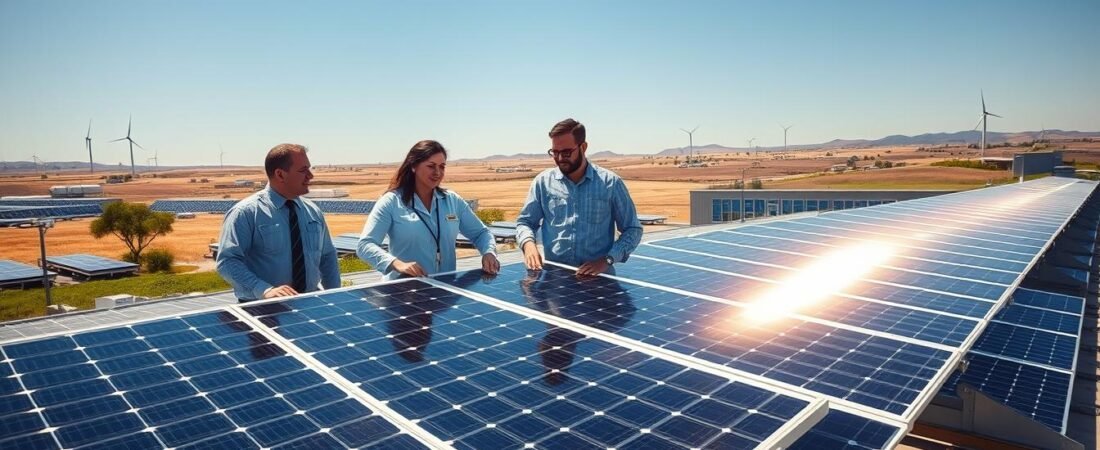
Good Faith Energy brings over 12 years of hands-on experience to every commercial solar panel installation texas project. We serve local companies with practical plans that match real operational needs.
More than 3,000 clients across the state have trusted our team to reduce costs and boost sustainability. Each business receives a tailored approach that fits its goals and facility demands.
We build systems to last and focus on reliable performance for decades. Our friendly experts guide owners through options, incentives, and long-term upkeep so decisions feel clear and confident.
Key takeaways: Proven experience, customized plans, durable systems, and local support for businesses aiming to lower overhead and improve sustainability.
Why Texas Businesses Are Switching to Solar
As electricity prices climb, firms are rethinking how they secure reliable power for day-to-day operations. The state’s long sunlight hours make on-site generation a strong option for many companies. Adopting renewable systems can turn a volatile cost into predictable savings over decades.
Rising Energy Costs
Electricity costs have risen from 12.1¢ to 14.9¢ per kWh since 2021. That jump pushes up operating expenses and reduces margins for tight-budget businesses.
Moving to on-site solar energy helps lock in a steady price for 25+ years. This gives companies a clear way to manage future cost risk and improve long-term planning.
Energy Independence
Grid stress events in ERCOT have shown why resilience matters. Energy independence provides a vital advantage when outages or price spikes occur.
- Reduces reliance on utility price swings.
- Helps manage peak demand and protect operations.
- Delivers predictable savings and faster payback.
| Factor | Current State | Benefit of On-site Systems |
|---|---|---|
| Electricity price | 14.9¢/kWh (2021–present rise) | Fixes long-term power price |
| Grid reliability | Stress events and outages | Improves operational resilience |
| Market advantage | Competitive cost pressures | Lower operating costs and stronger margins |
Understanding Commercial Solar Panel Installation Texas
From site surveys to final grid connection, our crews have executed hundreds of energy projects for local businesses. Good Faith Energy handles every step — assessment, engineering, permitting, and final setup — so your team can focus on operations.
We design custom systems for schools, medical facilities, churches, and office complexes. Each solution matches the facility’s load, roof and site constraints, and long-term goals.
Our professional team manages permitting and follows local building codes and safety standards. We deliver turnkey service that minimizes disruption to day-to-day work.
- Tailored solar solutions for diverse facilities to meet specific energy commercial needs.
- Over 2,000 successful projects that integrate clean power into business operations.
- High-quality installations that maximize production and long-term performance.
Choose a partner focused on reliability — from initial site assessment to final interconnection, we back every project with technical support and industry-grade warranties. Learn more about our work and approach on our project page and partner resources.
commercial solar installation for Texas businesses | partner services
Financial Advantages and Tax Incentives
Smart tax planning can unlock significant value for a business considering a new energy system. Federal and state incentives make the initial investment far more affordable and shorten the payback timeline.
Federal Investment Tax Credit
The federal Investment Tax Credit (ITC) lets companies deduct 30% of total project costs from federal tax liability. For a typical 100kW system that costs about $200,000, that deduction is a substantial immediate benefit.
Property Tax Exemptions
Texas provides a 100% property tax exemption for qualifying installations. That means added property value from the energy system won’t raise local tax bills.
Accelerated Depreciation
Using accelerated depreciation rules, many businesses recover most of their outlay quickly. In practice, companies can recover up to 85% of system costs through tax benefits in the first year.
“Combining the ITC, state exemptions, and depreciation often turns a large upfront cost into near-term savings.”
- Lower net cost after federal and state incentives
- Faster return on investment and improved long-term value
- Guidance through tax claims to maximize available benefits
Evaluating Your Energy Needs
Knowing how your facility uses electricity across a full year lets us design a system that matches real demand. We analyze 12 months of utility bills to predict performance and avoid oversizing or shortfalls.
Our team runs roof structural engineering checks, shading studies, and irradiance modeling. This ensures your commercial solar solution is placed for maximum power and long-term savings.
- Certified analysts review usage patterns and grid interconnection needs to optimize system sizing.
- Detailed roof and shading analysis protects your investment and maximizes energy production.
- We model year-round performance so your business can plan operations, costs, and expected savings.
We also map available incentives and tax credits that can lower upfront investment and speed payback. The result is a clear, data-backed recommendation that fits your energy commercial profile and long-term goals.
Types of Solar Systems for Commercial Properties
Rooftop and carport options offer flexible ways to add renewable power without losing useful land.
Rooftop arrays require minimal land and often cost less than ground-mounted alternatives. They use existing roof area and avoid extra site work. Most businesses see faster payback because rooftop systems reduce upfront site costs.
Rooftop Arrays
We specify high-efficiency 72-cell modules, about 6.5 ft by 3.25 ft, to maximize output. These modules fit tight roof layouts and deliver steady energy year-round.
Solar Carports
Carports add covered parking plus useful generation. They protect vehicles and create premium space for harvesting power. Carports are ideal where rooftop area is limited or shaded.
- Maintenance programs keep rooftop and carport systems performing well.
- We evaluate cost, efficiency, and available space to recommend the best configuration.
- Our team manages the full installation process to meet industry standards.
| Feature | Rooftop Arrays | Carport Systems |
|---|---|---|
| Land use | Uses existing roof, minimal ground impact | Requires parking area, dual-use benefits |
| Typical cost | Lower site prep costs | Higher structural and canopy costs |
| Typical modules | 72-cell modules (≈6.5′ x 3.25′) | 72-cell modules mounted on canopy |
| Use case | Buildings with strong roof area | Facilities needing shade and extra generation |
The Role of Battery Storage and Grid Resilience
Integrating battery storage with a commercial solar system gives businesses a dependable backup when the grid goes down. Good Faith Energy has installed over 2,500 batteries for clients, proving our ability to design systems that protect critical operations.
Batteries capture excess daytime output so you can use that energy during peak hours or outages. That reduces electricity costs and increases overall savings. Most local utilities also offer buyback programs for surplus generation, which further improves the return on your investment.
- Resilience: Keeps lights, servers, and essential equipment running during blackouts.
- Control: Shifts stored energy to lower costs and manage demand charges.
- Value: Enhances your energy solutions and strengthens long-term systems performance.
Combining storage with on-site generation signals a commitment to reliability and sustainability. We guide you through incentives, tax considerations, and utility rules so your investment delivers measurable savings and stronger grid resilience.
Our Professional Installation Process
We start with a structured site assessment so the design fits your roof, loads, and long-term goals.
Site Assessment and Engineering
A certified team performs detailed surveys, structural checks, and shading studies. NABCEP-certified installers plan projects to meet schedule and safety standards.
We coordinate permitting and utility interconnection to avoid delays. Final inspections and system commissioning confirm performance before handoff.
- Full-service project management: from site survey to final commissioning.
- Minimal disruption to your daily operations during on-site work.
- Transparent review of costs, tax incentives, and expected returns on your investment.
With more than 2,000 successful projects, our team handles complex grid requirements and compliance. Let us manage the technical details so you can focus on running your business.
See our installation projects for examples and next steps.
Maintenance and Long-Term System Performance
A short yearly inspection protects your investment and keeps output steady for decades.
Regular maintenance is essential. We recommend an annual check by a GFE technician to verify output and safety. These reviews catch small issues early so repairs stay simple and costs stay low.
Most systems include a 25-year warranty and many last up to 30 years with proper care. Routine service preserves efficiency and extends useful life, protecting both the roof and the array above it.
Our service keeps your panels producing reliable power and maximizes long-term savings. We document findings, handle replacements under warranty, and advise on tax or incentive paperwork when relevant.
- Annual inspection by a trained technician
- Warranty support and timely repairs
- Roof protection and extended system life
| Item | Recommended Interval | Benefit |
|---|---|---|
| Performance check | Annual | Maximizes output and detects faults |
| Warranty review | As needed | Protects investment and reduces cost |
| Roof and hardware inspection | Annual | Prevents weather damage and extends life |
For ongoing support and additional maintenance resources, see our maintenance resources to plan the best long-term care for your project.
Integrating Electric Vehicle Charging Infrastructure
High-speed charging stations paired with on-site generation can transform an ordinary lot into a profitable destination.
The Tesla V4 Supercharger System is built for high-volume use and works well with rooftop or ground-mounted systems. Pairing fast chargers with on-site generation reduces grid draw and lowers operating costs.
Businesses can set their own pricing and start earning revenue from day one. Charging is one of the fastest-growing opportunities in energy and transportation, and demand keeps rising.
- Ultra-fast charging: Integrate Tesla V4 to serve many drivers quickly while easing grid reliance.
- Scalable solutions: We design systems to match your energy needs and future growth.
- Turnkey service: Our team handles panels, chargers, and commissioning so your project runs smoothly.
- New revenue: Offer pricing that fits your market and lower net costs by using stored or on-site power.
- Ongoing support: We provide maintenance and monitoring to keep chargers reliable for all EV models.
Pairing chargers with clean generation modernizes your facility and positions it for long-term demand.
Sustainability Goals and Corporate Branding
Businesses are adopting clean energy to meet ESG goals and make sustainability a visible part of their brand.
Adopting commercial solar helps manufacturers and industrial firms lower long-term electricity costs. It also hedges against volatile grid pricing and protects operations from rising rates.
Our custom systems deliver both environmental and financial value. A well‑planned project brings measurable savings and strengthens investor confidence.
Branding matters: high‑visibility renewable projects show customers and stakeholders you lead on sustainability. That reputation boost often translates into market advantage and higher perceived value.
- Helps manufacturing meet ESG targets while cutting electricity costs.
- Makes your investment in solar power a clear signal of responsibility.
- We guide you to leverage federal tax incentives and utility programs for added value.
“A strategic solar project can turn operational savings into a long‑term branding win.”
Conclusion
A well-planned system can turn rising energy costs into a predictable advantage for any business. It stabilizes power spend and helps you compete in a volatile market.
Our experienced team guides the process from first quote to final installation, keeping projects on time and within budget. Manufacturing sites and office complexes both see increased property value and lower operating price pressure.
Take advantage of current tax incentives to boost returns and secure long-term savings. Contact our friendly team today for a custom energy quote and start modernizing operations with reliable power.