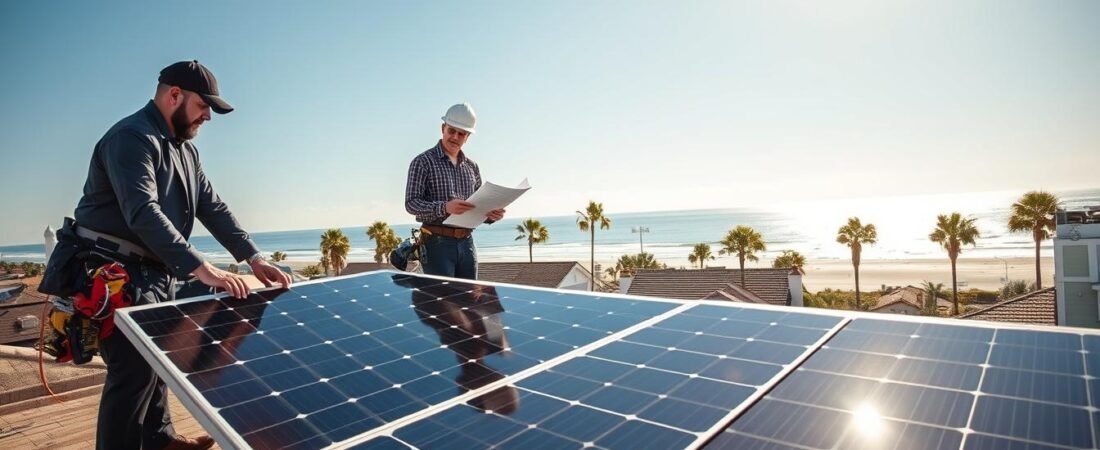
Finding reliable installers is the first step toward energy independence for homes in the 48167 area. Our short guide highlights top-rated teams that focus on quality workmanship and code-compliant work.
When you choose a professional, you get expert advice on the right equipment, system sizing, and battery options. These providers handle permits, meter work, and interconnection to keep projects moving smoothly.
Quality matters: well-designed systems aim to maximize efficiency and last for decades. Picking a trusted local firm also helps with climate-specific challenges and long-term service.
For a seamless, full-service approach and a free quote, consider a local specialist like Texas Direct Solar. Their family-owned focus and financing options can make the switch easier and more reliable for your property.
Why Galveston is Ideal for Solar Energy
Galveston’s coastal climate makes it an excellent spot for homeowners who want reliable, long-term energy savings. The region gets plenty of clear days and steady sun, so systems produce well across seasons.
Climate Advantages
The area enjoys about 234 sunny days each year. That means more productive days for a rooftop system and steadier returns on your investment.
The semi-arid coastal setting also reduces heavy cloud cover most of the year. This supports consistent electricity production for many years.
Solar Irradiance Potential
Daily sunlight averages 7–8 hours. With that level of irradiance, high-efficiency panels can generate significant power for a home across all seasons.
At an average electricity rate of 11.36¢/kWh, many homeowners are shifting to onsite power to cut monthly bills. For current local rates, see local electricity rates.
- 234 sunny days — reliable sunlight through the year.
- 7–8 hours daily — strong daily production potential.
- 11.36¢/kWh average — financial incentive to go renewable.
| Metric | Value | Why It Matters |
|---|---|---|
| Sunny days per year | 234 | More sun = higher annual energy output |
| Average sunlight | 7–8 hours/day | Supports steady daily generation |
| Average electricity rate | 11.36¢/kWh | Improves payback prospects for homeowners |
Top-Rated Solar Panel Installation Companies Galveston TX
Local ratings show which providers deliver consistent results and strong customer satisfaction.
Key local choices include Coastal Eco Heating & Air, which holds a 4.9 rating from 41 reviews. That score makes them a standout for homeowners seeking reliable service.
Texas Direct Solar also posts a 4.9 rating with 45 reviews and brings years of experience in the regional business. Solstice Solar appears next with 330 reviews, known for dependable results on larger projects.
- Freedom Solar Power — 396 reviews, extensive commercial and residential experience.
- Solar Supply — 4.4 rating; compare offers to find the best panels and pricing.
Use ratings and review counts as a quick data check. Look for warranties, local support, and customer feedback to match the right provider to your power needs.
Understanding the Solar Installation Process
A step‑by‑step plan makes it easy to follow progress from contract signing to final grid tie‑in. Below are the main stages you will see during a typical home upgrade.
Site Assessment and Permitting
First, a crew inspects your roof, shading, and meter location. They size the system and list the required equipment.
Typical timeline: permitting and approvals usually take several weeks. The average project spans 4–8 weeks from contract to activation.
Installation Day
On the scheduled day, crews mount racking, run wiring, and attach modules and inverters. Most residential work finishes in 1–3 days after permits are cleared.
System Inspection
A local inspector checks electrical work and safety compliance. Once approved, the utility grants interconnection and your system can go live.
| Stage | Duration | Key Task |
|---|---|---|
| Assessment & Permit | 1–4 weeks | Site survey, permits |
| Installation | 1–3 days | Racking, wiring, equipment setup |
| Inspection & Interconnect | 1–2 weeks | Safety checks, utility approval |
Residential Versus Commercial Solar Solutions
Homes and businesses have different goals, and each needs a tailored approach to onsite power.
Residential systems are sized for living needs, daytime use, and backup during outages. Homeowners gain higher property value and steady savings.
Commercial solutions focus on larger loads for farms, ranches, and small business sites. These setups help a business stabilize operating costs and manage peak demand.
- Local firms design customized solar panel systems based on actual energy profiles.
- Commercial power systems can offset heavy usage and improve long‑term budgets.
- Residential panels deliver energy security and improved resale value for a home.
- From small rooftop setups to large-scale installations, providers tailor the panel arrangement to match site needs.
Choose the right path by matching systems to daily loads and growth plans. A focused quote will show expected savings, lifespan, and warranty options.
Maximizing Your Savings with Solar Incentives
Federal and state programs make many systems more affordable than they appear at first glance.
Federal and State Tax Credits
Federal Investment Tax Credit (ITC) allows homeowners to claim 30% of eligible costs back as a tax credit. This credit applies to equipment, labor, and permitted fees for a qualifying installation.
Texas solar policies also help. Net metering and utility-level rebates allow both homeowners and small business owners to capture extra value from onsite generation.
- ITC — 30% credit on qualifying costs, lowering upfront expense.
- Net metering credits exported power to your account for future savings.
- Many local companies assist with rebate paperwork and incentive stacking.
- Using these programs improves long-term savings and return on investment for your system.
Talk with a qualified installer to map available incentives to your site. That simple step often reveals predictable savings and a shorter payback horizon.
Key Factors to Consider When Selecting an Installer
Pick an installer who clearly explains costs, timelines, and the exact equipment they will use. Clear communication helps avoid surprises and speeds up the installation process.
Verify licensing and local experience. Ask for proof of permits, trade licenses, and recent project references in your area.
Check ratings and reviews. Look for consistent high scores and repeat positive feedback. Reviews provide useful data on quality, on-time work, and service after activation.
- Transparent pricing: Request itemized quotes so you can compare equipment, labor, and permit fees.
- Equipment and quality: Confirm the exact panels, inverters, and mounts the installer plans to use.
- Experience: Prefer teams with real-world experience handling similar roofs and panel installation challenges.
- Compare multiple companies: Getting three quotes gives context on pricing and expected performance.
Use these factors to narrow choices to firms with strong ratings and clear data. That approach protects your investment and improves long-term satisfaction.
Financing Options for Your Solar System
Financing options can turn a costly upgrade into manageable monthly payments that fit most budgets.
Many local providers offer flexible choices: leases, power purchase agreements (PPAs), and zero‑down plans for a new system.
- Compare terms: check the company’s rating and customer reviews to confirm reliable service and clear pricing.
- Ask about equipment: a qualified installer with real experience will explain which panels and inverters suit your energy needs.
- Spread the cost: financing lets you pay over time while your system begins to reduce bills.
- Transparent pricing: top firms outline fees, expected savings, and warranty coverage so you know long‑term value.
Before signing, request an itemized quote and verify the installer’s local experience. That simple step helps protect your investment and makes the switch to clean energy easier to manage.
Environmental and Economic Benefits of Switching
Switching to onsite generation cuts greenhouse gases while trimming monthly bills. This move lowers household emissions and reduces reliance on grid power. It also offers steady long‑term savings that many owners appreciate.
State incentives and the federal tax credit can significantly improve your payback timeline. For a small upfront outlay, incentives boost the overall value of a new system and reduce net costs.
- Lower carbon emissions and improved local air quality.
- Use incentives and credits to shrink upfront expense and speed payback.
- Many local reviews show high customer satisfaction and lasting savings.
- Reliable equipment helps secure energy independence and shields you from rising rates.
| Benefit | Environmental Impact | Economic Outcome |
|---|---|---|
| Clean generation | Less CO2 and cleaner air | Reduced utility bills |
| Incentives | Encourages adoption statewide | Lower net cost, faster ROI |
| Equipment reliability | Fewer outages, stable power | Longer system life, more savings |
Conclusion
Picking a trusted local team ensures your home or business receives reliable service and measurable results.
With about 234 sunny days and strong federal incentives, Galveston offers real potential for long‑term energy savings. Compare top providers by experience, customer reviews, and the quality of their equipment to find the best match for your needs.
The entire process — from site assessment to final inspection — is designed to deliver a safe, code‑compliant system that performs well for years. Look for clear pricing, solid warranties, and high ratings in local reviews.
Take time to gather data, get multiple quotes, and confirm incentives. Doing so helps homeowners claim significant savings and enjoy greater energy independence for many years to come.